Programme
17th EAOHP Conference, 15th-17th June, 2026Preliminary Programme
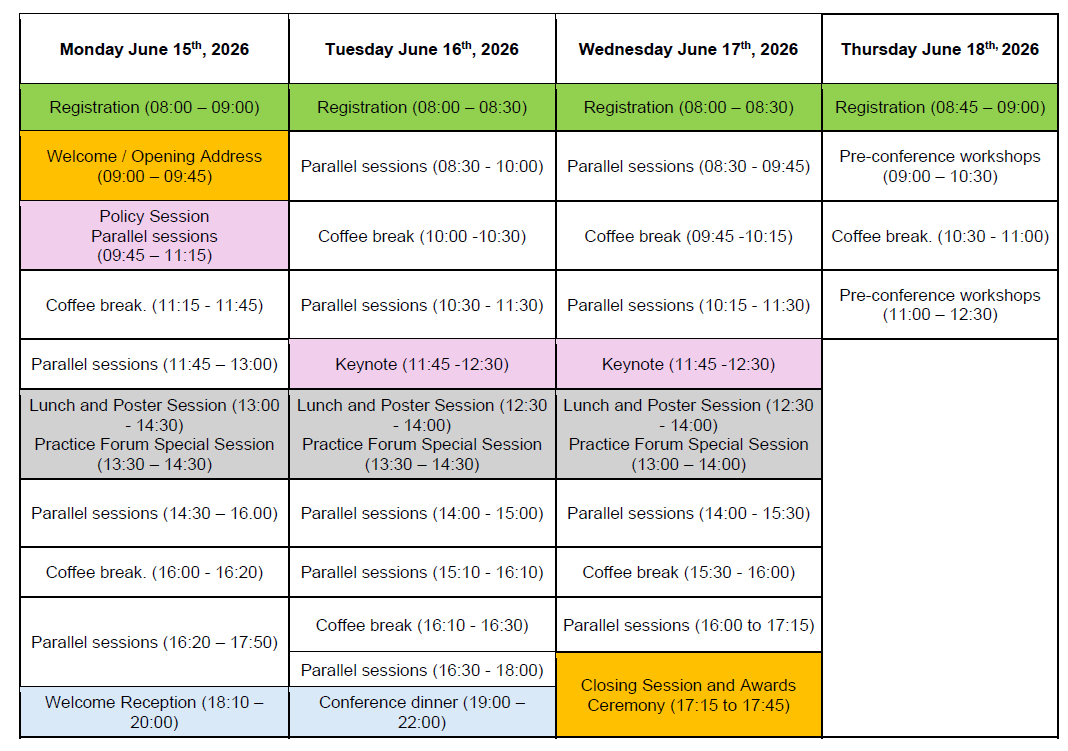
The EAOHP 2026 Conference main event will take place between 15 and 17 June, while a selection of post-conference workshops will be held on 18 June 2026.
The EAOHP 2026 Conference will take place at the University of Helsinki, situated right in the vibrant city centre of Helsinki, Finland.
Venue address:
Address: Fabianinkatu 33, Helsinki, Finland
Practice Forum Special Sessions
The EAOHP’s Practice Forum, in collaboration with the Finnish Institute of Occupational Health (FIOH), will deliver a selection of special sessions throughout the conference days. The aim of these sessions is to promote the discussion regarding practical solutions and challenges of collaboration models and roles in supporting mental well-being at workplaces among practitioners and OHS specialists collaborating with workplaces.
The Role of Occupational Health Care Collaboration
This session will explore the role of OHS in supporting mental wellbeing of employees. The focus will be on proactive strategies and interventions to support and manage psychosocial risks and support mental health challenges in the workplace. Key topics: organization of employee health care, multiprofessional collaboration and evidence-based approaches.
Session delivered by the Occupational Health Care Unit, FIOH
Occupation Safety Collaboration and Practices
Focusing on the role of occupational safety, this session will examine how workplace policies and practices can be designed to manage risks and simultaneously promote mental well-being. Key topics: psychosocial work environment in supporting mental health (or employee work ability), improving safety culture and resilience, and ensuring alignment between physical and mental health initiatives.
Session delivered by the Occupational Safety Unit, FIOH
Best Practices and Research Models
This concluding session will focus on synthesizing best practices and presenting innovative research models that enhance mental well-being through workplaces. Participants will gain insights into successful national and international interventions and frameworks that have been studied and/or implemented. The session will also provide human resource specialists, supervisors, researchers and practitioners with an opportunity to discuss ways of improving mental health of employees and potential collaborative projects.
Session delivered by the Work Ability and Work Careers Unit, FIOH
Post-conference workshops
Multilevel modelling with R: An introduction with applications on wearable- and mobile-based intensive longitudinal data
The R programming environment offers powerful and open-source tools for modelling hierarchical and repeated-measures data, such as those collected with intensive longitudinal designs (ILD), which are increasingly popular in occupational health psychology research. This workshop provides an accessible introduction to multilevel modelling using R (primarily with the lme4 package), focusing on practical applications involving mobile-based experience sampling methods (ESM) and wearable-derived physiological monitoring. Participants will work with real-world datasets to learn how to structure, model, and interpret repeated observations nested within individuals. The course is particularly suitable for researchers interested in multilevel modelling, intensive longitudinal data and/or ESM and wearable technologies. Participants are requested to bring their laptop with R and RStudio already installed. Participants should have some basic knowledge on linear and multiple regression. Familiarity with R is not strictly required but recommended – some basic introduction is available here
*For this workshop, participants are required to bring their laptops with R and RStudio already installed.
Facilitator: Luca Menghini, Assistant Professor of the Department of General Psychology and Human-Inspired Technology Research Centre at the University of Padova.
Qualitative Research in Occupational Health Psychology
This workshop aims to introduce/ address the role of qualitative research in Occupational Health Psychology (OHP)and explore and illustrate methodological strategies. The workshop was designed for PhD students, early-career researchers, and junior academics that do not have (or have little) experience in conducting qualitative research. In the first part, we will discuss why qualitative approaches are essential for understanding OHP issues related to safety at work, and employee well-being and stress, supported by examples. The second part focuses on practical skills: designing and conducting interviews and applying diverse analytical approaches. Through interactive exercises, participants will gain hands-on experience in collecting and interpreting qualitative data. Finally, we will address common challenges in qualitative research while sharing strategies to overcome them.
Facilitators: Rachel Nayani, Associate Professor, Norwich Business School and University of East Anglia and Sílvia Agostinho da Silva, Full Professor, Iscte-Instituto Universitário de Lisboa and Research Forum Chair, EAOHP
Session delivered by the Occupational Safety Unit, FIOH
Τhe Road to Publishing in High-Impact Academic Journals: A Ηow-Τo Workshop
The main aim of this workshop is to support PhD students, early-career researchers, and junior academics in navigating the often complex and competitive publication process in peer-reviewed, high-quality academic journals. The workshop will provide a unique overview on the full publication process from writing a successful paper to selecting the best outlet and preparing the manuscript for submission, as well as the review process. Emphasis will be placed on writing tips, dos and don’ts, identifying potential journals for publication and journals’ expectations, as well as on how to successfully address the comments of the reviewers. There will be room for group exercises (e.g., reviewing good and bad examples, reviewing participants’ own work) and discussion. At the end of the workshop, attendees will be equipped with the knowledge and confidence needed to enhance their research papers and increase their chances of publication success.
Facilitators: Anne Mäkikangas, Full Professor & Director of the Work Research Centre, Tampere University, Finland and Associate Editor, Work & Stress & Consulting Editor, Journal of Occupational and Organizational and Despoina Xanthopoulou Full Professor, Aristotle University of Thessaloniki, Greece, Education Forum Chair, EAOHP and Associate Editor, European Journal of Work and Organizational Psychology.
Dyadic Studies in Occupational Health Psychology: Best practice guidelines from developing and implementing research ideas to data analyses
The main aim of this workshop is to present and discuss best practice guidelines for conducting dyadic studies in the field of occupational health psychology. The workshop will provide information on exemplary dyadic studies (including dyadic diary and intervention studies) investigating different dyadic relationships relevant to the workplace, such as romantic partners, colleagues, and patient-caregiver dyads. We will focus on sharing hands-on experience of successful research practices (what works) and enable participants to develop and plan their own dyadic research ideas.
The workshop will also teach participants how to analyse dyadic data using the Actor-Partner Interdependence Model (APIM), covering both its foundational application, model specification for distinguishable and indistinguishable dyads, extensions for specific research questions, and its utility for more complex research designs (e.g., dyadic diary data). Participants will gain the background and practical skills necessary to accurately model dyadic interdependence and derive meaningful conclusions from their occupational health data.
All examples and exercises provided during the workshop will use R with lme4 and lavaan. Participants are expected to have some familiarity with R (but do not necessarily need to be proficient) as well as some understanding of multilevel modelling and structural equation modelling techniques.
Facilitators: Carmen Binnewies, Full Professor of Work Psychology, University of Muenster, Germany and George Michaelides, Full Professor of Work Psychology, University of East Anglia.