

On 30 September 2026, Eurocadres brought policymakers, trade unions and researchers to the European Parliament for a session titled “Impact, not ideology: Finding solutions for European workers”. Hosted by MEP Estelle Ceulemans (S&D, Belgium) and moderated by Kevin Flynn of Eurocadres, the event asked whether Europe’s approach to work-related psychosocial risks (PSR) is working. Across the evening, speakers agreed that awareness-raising has dominated EU action so far, and that prevention must now take centre stage.
The timing of the event was significant given recent policy developments. The European Parliament’s Employment Committee had just adopted MEP Ceulemans’ legislative-initiative report calling for an EU law on psychosocial risks, and on 6 October, less than a week after the event, the full Parliament backed it in plenary. MEPs are calling for obligations on employers to protect workers’ mental and physical health, including regular psychosocial risk assessments and action plans, policies against violence, harassment and bullying, and individual return-to-work plans. They also want explicit recognition that psychosocial risks give rise to occupational diseases. Meanwhile, the Commission is preparing its Quality Jobs Act and EU-OSHA is launching a new Healthy Workplaces campaign in this area.
Reflections from the panel discussion
The first panel discussion of the evening asked whether current legislation is sufficient. Annukka Ojala, from the cabinet of Executive Vice-President Roxana Mînzatu, noted that the 1989 Framework Directive already covers all risks, psychosocial ones included, but agreed that more is needed and pointed to the ongoing consultation on the Quality Jobs Act. MEP Estelle Ceulemans set out the approach in her report which presents the text of a draft Directive on PSR. This involves a need for systematic risk assessment and action plans, recognition of burnout as an occupational disease, and a reversal of the burden of proof. Eurocadres President Nayla Glaise argued that Europe cannot be competitive if its workers are sick, and that only binding, standalone legislation will make employers’ responsibilities clear.
Liam O’Brien of the Australian Council of Trade Unions offered a perspective from Australia. Here, psychosocial hazard regulations were introduced five years ago to require employers to manage psychosocial risks systematically in the same way as physical ones. The impact of this is clear, where mental health-related claims have now plateaued, and an estimated three-to-one return-on-investment for spending on preventative actions.
The second panel delivered a clear message that every sector across Europe is struggling with PSR. Jan Willem Goudriaan (EPSU), Tom Deleu (EFBWW) and Jelmer Evers (ETUCE) described mounting pressures in public services, construction and education, from austerity to unclear rules, with effects reaching students and service users. However, French labour inspector Cécile Clamme cautioned that legislation alone is not enough, and that inspectors need the tools, guidance and resources to enforce it.
From sickness to solution: what action can be taken against PSR?
EAOHP President Professor Stavroula Leka closed the evening with the research evidence. Nearly one in three EU workers report job-related stress, depression or anxiety, and five psychosocial work exposures account for 17–35% of depression. She stressed that work-related stress is an outcome of exposure to psychosocial risks, not a risk in itself, so prevention must target work organisation.
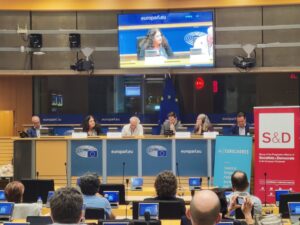
At the core of her keynote was the new ETUI mapping of regulation, collective agreements and jurisprudence on PSR in all 27 EU Member States. While 19 countries mention PSR in legislation, only six define it, and only Belgium defines work-related stress. In eight countries, case law has filled the legislative gap which leaves workers and employers facing legal uncertainty.
The mapping shows that legislating on PSR is possible. Professor Leka called for an EU Directive on psychosocial risks and mental health at work, prevention at source rather than resilience-building, learning from existing national approaches, stronger social dialogue, and an end to legal uncertainty. From here it is clear that Europe knows how to legislate on psychosocial risks, and that now is the time to do so at EU level.
What comes next
With Parliament’s backing secured, the next move is the Commission’s. It has three months to respond, either by setting out the steps it will take or by explaining why it will not propose legislation. The coming months will show whether the EU moves from recommendations to binding prevention. EAOHP will continue to work with different stakeholders to bring research evidence to this debate.