
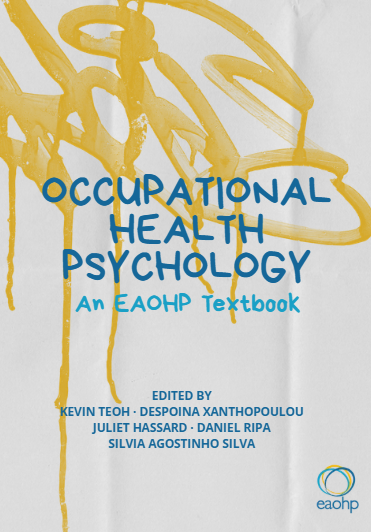
Occupational Health Psychology: An EAOHP Textbook
Editors: Teoh, K., Xanthopoulou, D., Hassard, J., Ripa, D., Agostinho Silva, S.
ISBN (Print version): 978-0-9928786-8-9
ISBN (Electronic version): 978-0-9928786-9-6
Published: June 2026
Occupational Health Psychology (OHP) is the scientific discipline dedicated to understanding how the characteristics of work and the work environment, and their interplay with the macro-level social, economic, political, technological and ecological context, determine workers’ health, safety and wellbeing, and therefore organisational and societal prosperity and sustainability.
This edited textbook, the first official volume published by the European Academy of Occupational Health Psychology (EAOHP), provides an up-to-date introduction to the dynamic field of OHP in Europe and beyond. By synthesising theory, research, policy and practice, it aims to establish a common foundation of knowledge for students, researchers and practitioners, supporting the standardisation of OHP education, and seeks to stimulate further research by highlighting gaps in understanding and identifying areas for future investigation. Every chapter is authored by experts in their respective fields who provide a balanced perspective across three essential pillars of (i) research; (ii) practice; and (iii) policy. In doing so, the textbook seeks to equip readers with the theoretical knowledge and understanding of how to translate that evidence into persuasive rationales for organisational and societal change.
About the Book
Get Your Copy
The textbook is available globally in both print and digital formats. Please choose the option that best applies to you:
General Purchase: You can order your copy in print or ebook format via Amazon or IngramSpark.
EAOHP Members: As a benefit of your membership, you are entitled to a complimentary ebook copy. EAOHP Helsinki attendeees can download this here.
Existing Members: Your free copy will be made available after EAOHP Helsinki 2026 Conference.
New Members: Access will be provided following the membership sign-up process.
Not a member yet? Learn more about joining the Academy and accessing your member benefits
Book Chapters
1. An Introduction to Occupational Health Psychology
Kevin Teoh, Juliet Hassard, Silvia Agostinho Silva, Despoina Xanthopoulou, Daniel Ripa, and Stavroula Leka
2. Psychosocial Risk Management at Work: Policy, Legislation, and Standards
Stavroula Leka and Aditya Jain
3. Understanding Work-Related Stress
Anne Mäkikangas, Ulla Kinnunen, and Sampsa Puttonen
4. Beyond Burnout: Advancing Work Engagement through Job Demands-Resources Theory
Evangelia Demerouti and Arnold B. Bakker
5. Social Determinant of Occupational Health Inequalities
Pablo Ruisoto, Ferran Muntané, Carles Muntaner, and Joan Benach
6. Job Insecurity and its Role for Occupational Health and Wellbeing
Hans De Witte
7. Workaholism and Occupational Health
Toon Taris and Jan de Jonge
8. The Role of Organisational Culture and Function for Worker Wellbeing
Fiona Frost, May Young Loh, Ashira Friebel, and Maureen Dollard
9. Leadership and Work-Related Wellbeing
Ilke Inceoglu and Didem Sedefoglu-Ulucak
10. Workplace Bullying and Harassment: A Distinct Occupational Hazard
Ståle Valvatne Einarsen and Iselin Reknes
11. Emotion Work and Occupational Health
Dieter Zapf, Marcel Kern, Andrea Fischbach, Kai Trumpold, and Norbert K. Semmer
12. Connecting Occupational Health Psychology with Human Factors/Ergonomics
Jodi Oakman, Laura Fruhen, and Lisette Kanse
13. A Multilevel Perspective for Promoting Workplace Safety and Preventing Work Accidents
Sharon Clarke
14. Work-Life Spillover and Occupational Health
Carmen Binnewies, Sophie Loose, Linda-Elisabeth Reimann, and Ann-Katrin Wolf
15. Health and Attendance at Work: Understanding Sickness Absenteeism and Presenteeism
Mariella Miraglia, Maria Karanika-Murray, and Caroline Biron
16. Business Responsibility and Sustainable Work
Daniel Ripa and Aditya Jain
17. Neurodiversity in the Context of Work, Employment, and Society
Almuth McDowall, Aishwarya Srinivasan, and Julia Gawronska
18. Occupational Health and Wellbeing of an Ageing Workforce
Annet de Lange and Trude Furunes
19. Digitalisation and the Future of Employee Health and Wellbeing
Tahira M. Probst, Mindy K. Shoss, and Sarah Bankins
20. Interventions to Promote Healthy Workplaces
Marit Christensen, Annet de Lange, and Glorian Sorensen
21. Research Methods in Occupational Health Psychology
Dorota Reis and Laurenz L. Meier
22. Reflections and the Future of Occupational Health Psychology
Kevin Teoh, Despoina Xanthopoulou, Daniel Ripa, Juliet Hassard, and Silvia Agostinho Silva
About the Editors
Kevin Teoh is Chartered Psychologist and Reader in Work and Organisational Psychology at Birkbeck, University of London, United Kingdom. He is also the Executive Officer for the European Academy of Occupational Health Psychology. His primary research interests are around psychosocial risk management, including intervention implementation and evaluation, and the translation of research into practice, policy, and public dissemination. Kevin is on the editorial boards of Work & Stress and the Journal of Occupational and Organizational Psychology. He has received awards including from the Society of Occupational Medicine and the British Psychological Society, and is a regular speaker at academic, professional, and public events.
Despoina Xanthopoulou is Professor of Organisational Psychology at the School of Psychology, Aristotle University of Thessaloniki, Greece. She is also the Education Forum Chair for the European Academy of Occupational Health Psychology. Her research interests include job (re)design and job crafting, (job and personal) resources, employee wellbeing, and recovery from job demands. Also, she specialises in advanced research methodologies (i.e., quantitative diary studies). She is Associate Editor of European Journal of Work & Organizational Psychology, and she serves at the editorial boards of Journal of Occupational Health Psychology, Occupational Health Science and Stress & Health. Despoina is also actively engaged in practice, collaborating with social partners, organisations, and employees to improve work environments.
Juliet Hassard is Reader in Work, Health and Employment at Queen’s Business School, Queen’s University Belfast, United Kingdom, where she also serves as Director of Postgraduate Research. She is the Publications Officer for the European Academy of Occupational Health Psychology. Her research focuses on psychologically safe and healthy workplaces, particularly the prevention and management of work-related stress and the links between workplace mental health and employee productivity. Juliet has advised national and international policy bodies, including the UK Government and the World Health Organisation, and received an Early Career Achievement Award in 2021 for her contributions to occupational health psychology.
Daniel Ripa is Assistant Professor of Organisational Psychology at the Complutense University of Madrid, Spain, and the Practice Forum Chair of the European Academy of Occupational Health Psychology. He holds degrees in Psychology and Labour Policies and a European PhD in Social and Work Psychology from the University of Oviedo. He has been a visiting scholar at ten international universities and worked at the International Labour Organisation (ILO). His research focuses on sustainable employment and the prevention of psychosocial risks from a comparative international perspective, analysing how public policies and corporate responsibility shape occupational health and workers’ wellbeing. His work has been presented at over 30 international conferences and published in leading journals, academic books and an ILO report. He also served as a Member of the Regional Parliament in Asturias, Spain (2015–2023), and collaborated with the Spanish Ministry of Labour.
Sílvia Agostinho Silva is Full Professor of Human Resources and Organisational Behaviour at Iscte-Instituto Universitário Lisboa and a researcher at BRU-Iscte, Portugal. She is the Research Forum Chair of the Executive Committee of the European Academy of Occupational Health Psychology. She is a licensed psychologist registered with the Portuguese Ordem dos Psicólogos (OPP). Her research focuses organisational and group factors (climate, practices, norms) and their links with health and safety outcomes (e.g., safety behaviour, burnout). She led national and international projects and collaborated with organisations aiming workplace safety and health promotion. She was the Coordinator of the Committee on the Green Paper on the Future of Safety and Health at Work in Portugal.
About the Contributors
Arnold B. Bakker is Professor of Work & Organisational Psychology at Erasmus University Rotterdam, the Netherlands. He is the chair of the Center of Excellence for Positive Organisational Psychology and holds visiting professorships in Slovenia, Finland, and South Africa. Bakker is Fellow of the Association for Psychological Science, the European Academy of Occupational Health Psychology, the International Association of Applied Psychology, and Lingnan University. His research interests include JD-R theory, job crafting, playful work design, the work-family interface, burnout, and work engagement. Since 2014, he has continuously been included in Thomson Reuters’ list of “The World’s Most Influential Scientific Minds.”
Sarah Bankins is Associate Professor in Organisational Behaviour and Ethical AI at the Macquarie Business School, Macquarie University, Australia. Her research focuses on the implications of AI use in different contexts, the ethical deployment of AI technologies, and the future of work. She is a past Associate Editor of Group & Organization Management and is an Editorial Board member for the Journal of Organizational Behavior, Journal of Management, and Australian Journal of Management.
Joan Benach is Full Professor of Sociology and Public Health, co-director of the JHU-UPF Public Policy Center, and director of the Health Inequalities Research Group (GREDS-EMCONET) at Universitat Pompeu Fabra, Spain. His research mainly examines precarious employment, intersectional health inequalities, and political determinants of health from a critical, transdisciplinary, and systemic perspective. Joan has led major international projects, including collaborations with the World Health Organisation and European and Spanish public-health institutions. He has authored influential papers, books, policy reports, and conceptual frameworks on health inequities, employment relations, and social justice. His work integrates scholarship, policy engagement, and social activism aimed at addressing unfair and avoidable health inequalities across countries and populations.
Carmen Binnewies is Professor for Work Psychology at the University of Münster, Germany. Her research focusses on Occupational Health Psychology, particularly research on recovery from work-stress and the interplay between work and private life. Her work has been published in outlets such as Journal of Occupational Health Psychology, European Journal of Work and Organizational Psychology, and Journal of Organizational Behavior.
Caroline Biron is Professor of Occupational Health and Safety in the Management Department at the Faculty of Business & Administration, Université Laval, Canada, and researcher at VITAM – Centre of Research on Sustainable Health. She is also the Director of the Centre of Expertise for Occupational Health & Safety which supports research development and provides practical prevention tools for managers and organisations. Her work focuses mainly on presenteeism at work and the implementation of organisational interventions to reduce exposure to psychosocial risks.
Marit Christensen is Full Professor of Work and Organisational Psychology at the Department of Psychology at the Norwegian University of Science and Technology, Norway, where she leads Healthy Workplaces research group. Her primary research interests are related to healthy workplaces and mental health with focus on concepts like work engagement, meaning, retention, successful ageing, and burnout. She has also worked a lot with organisational interventions both in practical development and in research. She was a part of the development group of the ARK intervention programme for health promoting work in universities in Norway and also part of the EU H2020 project H-work: Multilevel interventions for promoting mental health in SMEs and public workplaces.
Sharon Clarke is Full Professor of Organisational Psychology at the Alliance Manchester Business School, University of Manchester, United Kingdom. She has research interests in safety culture, leadership, workplace stress, and wellbeing. She has published widely, and led externally-funded projects for UKRI, UK government, regulators, and the NHS. She is co-author of ‘Human Safety & Risk Management’ (CRC Press), now in its third edition. She is co-investigator for the UKRI-funded “Building a Secure & Resilient World” (SALIENT) Research Hub. She is Editor-in-Chief of the Journal of Occupational Health Psychology, and elected Lifetime Fellow of the European Academy of Occupational Health Psychology.
Jan de Jonge is Full Professor of Work and Sports Psychology at Eindhoven University of Technology (TU/e), The Netherlands, where he is part of the Human Performance Management group within the Department of Industrial Engineering and Innovation Sciences. His work focuses on optimising performance, motivation, and recovery in both work and sports contexts, with research spanning job stress, employee well‑being, sustainable performance, and the DISC‑R Model of job demands and resources. De Jonge has published extensively in leading journals, co‑edited influential books on contemporary work psychology, and contributes to advancing evidence‑based approaches to healthy, high‑performance working, and sporting environments.
Annet de Lange works as Work and Organisational Psychology Professor II at the Norwegian University of Science and Technology, Norway and as Endowed Professor of Sustainable Employability on the Labour Market at the Open University, Faculty of Psychology, Heerlen as well as Research Consultant at Berenschot in Utrecht, The Netherlands.
Hans De Witte was Full Professor in Work Psychology at the Faculty of Psychology and Educational Sciences of the KU Leuven, Belgium (Research Group Work, Organisational and Personnel Psychology, WOPP/O2L). He is academically active as ‘emeritus with assignment’ since his retirement in October 2023 and appointed as Extraordinary Professor at the North-West University of South Africa (Optentia Research Unit). His research includes the study of the psychological consequences of job insecurity, unemployment and temporary employment, as well as job stress (e.g., burnout) versus wellbeing at work (e.g., work engagement). In July 2022, he received a Lifetime EAOHP-Fellowship at the 15th EAOHP Conference “in recognition of an outstanding career contribution to the discipline of occupational health psychology”.
Evangelia Demerouti is Full Professor in Work and Organisational Psychology at the Eindhoven University of Technology, The Netherlands, Distinguished Visiting Professor at the University of Johannesburg and Lingnan University and member of the Board of Governors at Tilburg University. She is Fellow of the European Academy of Occupational Health Psychology and expert on the job demands-resources theory, job crafting, burnout, workplace interventions and organisational change. She is an associate editor of the Journal of Occupational Health Psychology and the president of the European Association of Work and Organisational Psychology. She is recognised by Clarivate as a Highly Cited Researcher in 2025.
Maureen Dollard is an Australian Research Council Laureate Fellow and Director of the Psychosocial Safety Climate Global Observatory at the Adelaide University, Australia. She is a Bradley Distinguished Professor and formerly an Honorary Professor at the University of Nottingham. She is internationally recognised for pioneering Psychosocial Safety Climate (PSC) theory. She has published six edited books and over 300 papers and chapters. She co-founded the Australian Workplace Barometer, StressCafé, and the Australian University Census on Staff Wellbeing and works closely with industry and unions to improve worker psychological health. Maureen is former board member of the International Commission on Occupational Health and is on the editorial board for Work and Stress, the Journal of Organizational Behavior (formerly), and the European Journal of Work & Organisational Psychology, and was foundation president of the Asia Pacific Academy for Psychosocial Factors at Work. She is a Fellow of the Academy of Social Sciences Australia and the European Academy of Occupational Health Psychology.
Ståle Valvatne Einarsen is Professor of Work and Organisational Psychology at the University of Bergen, Norway, acting as Head of the Bergen Bullying Research Group from 2003 to 2023. He is a founder-member of the International Association of Workplace Bullying and Harassment and was awarded a Fellowship of the European Academy of Occupational Health Psychology in 2020. His primary research interests are around psychosocial factors and leadership at work, particularly focusing on bullying and harassment in the workplace as well as destructive aspects of leadership. His research on workplace bullying and harassment also includes research in fields such as physiotherapy, medicine, biomedicine, law, and cross-cultural research.
Andrea Fischbach is Full Professor of Social, Work, and Organisational Psychology at the German Police University, Germany. She received her Diploma in Psychology at Goethe-University, Frankfurt, her PhD at Georg-August-University, Göttingen, and she has held a Junior-Professorship for Organisational Psychology at Trier University. She has published more than 70 professional journal articles and book chapters on emotional labour, job crafting, organisational justice, and work diversity (age/gender/culture), and their implications for both performance and worker health. She has led several funded research projects (1+ Million Euros) including one three-year project on emotional labour in retail stores. She co-edited with Benjamin Schneider the Special Issue of the Journal of Service Management Research, Emotional Labor and Service. Her research focuses on the dynamics of work conditions, leadership, and HR management to help understand what makes people engaged, motivated, and healthy at work.
Ashira Friebel is PhD candidate and Research Assistant at the Psychosocial Safety Climate Global Observatory, Adelaide University, Australia, specialising in organisational psychology and workplace mental health. Her doctoral research examines policy translation for mental health at work, with a focus on empowering key stakeholders and aligning organisational practices with Psychosocial Safety Climate (PSC) theory. She investigates how legislative and organisational policies influence workers’ rights, vulnerability reduction, and psychological health. Ashira contributes to ARC-funded research, applying quantitative and qualitative methods to advance evidence-based training and regulatory approaches that strengthen organisational antecedents of workplace wellbeing.
Fiona Frost is Postdoctoral Researcher at Nottingham University Business School, University of Nottingham, United Kingdom. Her research centres on employee wellbeing, with a particular focus on loneliness in work, remote and hybrid working, and the organisational conditions that shape these experiences. She has contributed to projects examining organisational culture within higher education, staff wellbeing across public-sector and healthcare settings, as well as international research on the implementation of ISO 45003:2021 and its role in strengthening psychosocial risk management and organisational approaches to mental health and wellbeing at work. Fiona is an active member of the European Academy of Occupational Health Psychology, serving as News and Media Editor and as co-chair of the EAOHP Conference Organising Committee.
Laura S. Fruhen is Assistant Professor at Radboud University in the Netherlands and an Adjunct Senior Lecturer at the University of Western Australia, Australia. Her research examines how individual and contextual factors – in particular leadership and work design- are linked to safety, health, and wellbeing. She studies these phenomena across various organisational levels, ranging from the production floor to senior managers. She regularly interacts with industry and practitioners to connect her research with practice. Her work has informed industry and regulatory practices in multiple countries, including the development of a Code of Practice on Workplace Mental Health in Australia.
Trude Furunes is Professor of Leadership at the University of Stavanger, Norway. She researches leadership and organisational behaviour, with particular emphasis on ageing at work, sustainable employability, and leaders’ attitudes toward older workers, alongside themes such as hospitality and tourism leadership, diversity leadership, and employee wellbeing. Furunes is Editor-in-Chief of the Scandinavian Journal of Hospitality and Tourism and is also involved in national knowledge exchange on ageing workers as a board member of the Centre for Extended Working Life.
Julia Gawronska is a Postdoctoral Researcher at Anglia Ruskin University, United Kingdom, with a background in psychology. Her research focuses on mental health, with a particular emphasis on vulnerable populations. Her work explores psychological wellbeing, access to support, and the structural inequalities affecting marginalised groups. In addition to academic research, Julia conducts project evaluations in the public sector, contributing evidence to inform policy and practice.
Ilke Inceoglu is Professor of Organisational Behaviour and HR Management at the University of Exeter Business School, United Kingdom. She holds a PhD in Organisational Psychology from the LMU Munich and is a Chartered Psychologist and Associate Fellow of the British Psychological Society. Her research focuses on wellbeing at work, leadership, the impact of technology on work behaviour and work/career transitions, and the multi-age workforce. Her aim with her work is to improve workplace wellbeing and leadership through evidence-based insights. She has published in leading journals including Journal of Occupational Health Psychology, Leadership Quarterly, Journal of Vocational Behaviour, and Organisational Research Methods.
Aditya Jain is Professor of Sustainable Work and Development at Nottingham University Business School, United Kingdom. He is External Relations Officer of the European Academy of Occupational Health Psychology, Chair of the ICOH Scientific Committee on Occupational Health & Development, and a member of BSI and ISO technical committees. His expertise lies in sustainable work and policy, specifically in relation to the role of public and organisational policy for the management of the psychosocial work environment, aimed at promoting mental health at work and wellbeing. He has published extensively and worked as an expert advisor and consultant to the European Commission, the WHO, the ILO, EU-OSHA, and in industry.
Lisette Kanse is Senior Lecturer in the School of Psychological Science at the University of Western Australia, Australia, where she also coordinates the Master of Business Psychology and Graduate Certificate in Business Psychology programmes. Her research focuses on human factors, work design, procedures, norms, organisational culture, and leadership, and how these shape safety, health, and everyday work practices. In this context, she has worked extensively with industry across Europe and Australia—including the chemical, oil and gas, mining, rail, and healthcare sectors—to advance and evaluate evidence-based, people-centred approaches to work health and safety.
Maria Karanika-Murray is Professor of Work and Organisational Psychology at the University of Leicester, United Kingdom. Her research focuses on wellbeing and performance and addresses a range of questions around their nature and management, including attendance behaviour, the work‑nonwork interface, organisational health interventions, and sustainable work. Her work on presenteeism was honoured with the Human Relations Paper of the Year Award 2020. She has delivered research for national research councils, European funders, charities, government, and industry, and has written widely for academic, policy, and practitioner audiences.
Marcel Kern is Professor of Work and Organisational Psychology at the University of Göttingen, Germany, and Co-Editor-in-Chief of Research for People in Organisations. He also serves on the advisory boards of the Journal of Service Management Research and the German Journal of Work and Organisational Psychology. His research focuses on occupational health and wellbeing, with particular emphasis on challenge and hindrance stressors, emotion work, organisational change and change management, and the implications of new work for employees and organisations.
Ulla Kinnunen is Professor Emerita of Psychology at the Faculty of Social Sciences, Tampere University, Finland. Her research has consistently focused on occupational wellbeing, examining the ways how stress, burnout, and recovery emerge in the lives of employees across diverse sectors. She has also made significant contributions to understanding job insecurity and temporary employment, and the complex interplay between work and family life. She has published extensively in international and national outlets, with her studies widely cited in the fields of psychology, organisational behaviour, and occupational health. She served as an Associate Editor of Work & Stress from 2009 to 2018.
Stavroula Leka is Professor of Organisations, Work & Health at Lancaster University, United Kingdom, and Director of the Centre for Organisational Health & Wellbeing. She is also Professor Emerita of Work & Health Policy at the University of Nottingham. She is the President of the European Academy of Occupational Health Psychology, fellow of the Academy of Social Sciences, and honorary fellow of the Faculty of Occupational Medicine in Ireland. Key themes in her research are the evaluation of work and health regulation and policy, work organisation and the management of the psychosocial work environment for business and societal sustainability, creating healthy work environments, and the promotion of mental health and wellbeing at work. She co-led the development of ISO 45003, the first international standard on psychological health and safety in the workplace, and has been acting as expert advisor, among others, to the World Health Organisation, the International Labour Organisation, the European Commission, the European Agency for Safety & Health at Work, and national governments in various countries.
May Young Loh is Research Fellow of Psychosocial Safety Climate Global Observatory at the Adelaide University, Australia. She studies psychosocial factors at work and psychological health and safety. She studies psychosocial factors at work and psychological health and safety. Her research focuses on Psychosocial Safety Climate (PSC), job design, and occupational health and wellbeing, with publications in leading journals including the Journal of Occupational Health Psychology, Journal of Occupational and Organizational Psychology, and Stress & Health. She has delivered invited talks and collaborated internationally, contributing to evidence-based policy and practice. She serves as Section Editor for Stress & Health and is the Executive Officer of the Asia Pacific Academy for Psychosocial Factors at Work.
Sophie Loose is Research Associate and PhD candidate in Work Psychology at the University of Münster, Germany. Her research focuses on affective processes in the context of work and leisure time, with particular interest in emotion regulation and employee wellbeing. She investigates how affect regulation strategies unfold across different daily contexts, such as work and physical activity. Her work places a strong emphasis on capturing dynamic fluctuations in affective experiences and regulation processes over time, aiming to better understand how individuals manage emotions across domains of everyday life.
Anne Mäkikangas is Full Professor and the Director of the Work Research Centre at the Faculty of Social Sciences, Tampere University, Finland. Her research focuses on occupational wellbeing and its individual-, job-, and organisational-level antecedents. Over the past decades, her work has evolved from job stress research to include also positive approaches to working life. Her current research interests include job crafting, psychosocial safety climate, workplace meetings, and new forms of work such as hybrid and multilocational work, and their implications for wellbeing and productivity. She currently serves on the editorial boards of Work & Stress (Associate Editor), Journal of Occupational and Organizational Psychology, Journal of Managerial Psychology, and Scandinavian Journal of Work and Organizational Psychology.
Almuth McDowall is Professor of Organisational Psychology in the School of Sciences at Birkbeck, University of London, United Kingdom. Almuth is committed to undertaking practice-focused research on neurodiversity at work, directs a research centre dedicated to this topic and is widely published in this domain. She has been called on as an expert researcher and keynote speaker by national and international organisations and policy makers. Her particular interest includes the wellbeing of neurodivergent workers and how to straddle a balance between support for potentially vulnerable talent while recognising and harnessing their strengths.
Laurenz L. Meier is Full Professor in Work and Organisational Psychology at the University of Zurich, Switzerland. His research explores how people experience and manage stress at work, how work impacts their mental health, and how it interacts with private life. He is particularly passionate about using longitudinal and quantitative diary study designs to capture the dynamic nature of these processes.
Mariella Miraglia is Reader in Organisational Behaviour and Human Resource Management at the University of Liverpool Management School, United Kingdom. Her primary research interests revolve around health and wellbeing in the workplace, with a particular focus on absenteeism and presenteeism. She also researches performance management practices, including supervisory feedback, as well as work design, with a specific interest in new forms of work. Her research has been published in leading academic journals and presented at academic and professional conferences. She is part of the editorial boards of Human Relations and Journal of Management Studies.
Ferran Muntané is Executive and Research Manager at the JHU-UPF Public Policy Center and Researcher with the Health Inequalities, Environment, and Employment Conditions Network (GREDS-EMCONET) at Universitat Pompeu Fabra, Spain. His work focuses on precarious work, social inequalities, labour market transformations, with particular attention to their implications for occupational health and public policy. He has contributed to several international research projects examining the structural determinants of health, with an emphasis on social justice, political economy, and collective action. Ferran has a background in political science and public health and has co-authored influential conceptual and empirical work on employment relations and health inequalities in Europe.
Carles Muntaner is Full Professor at the Bloomberg Faculty of Nursing, Dalla Lana School of Public Health, and Department of Psychiatry at the University of Toronto, Canada. He is internationally recognised for his work on employment relations, social class, mental health, and inequalities in labour markets. His research integrates political economy, occupational health, and social epidemiology, contributing extensively to international reports, comparative studies, and theoretical frameworks. Carles has held academic appointments in North America, Europe, and China, and has been a key contributor to landmark research networks such as EMCONET, focusing on structural determinants of health and population wellbeing.
Jodi Oakman is Professor at La Trobe University, Australia, and leads the Centre for Ergonomics and Human Factors. She leads research aimed at enhancing both physical and mental health in the workplace. Her innovative translational research includes the development of the APHIRM (A Participative Hazard Identification and Risk Management) Toolkit, which aids organisations in mitigating stress-related mental health issues and musculoskeletal disorders using a participative approach. Currently, she leads research based in systems thinking and principles of implementation science to advance work-related health and wellbeing and support sustainable working lives.
Tahira M. Probst is Professor of Psychology at Washington State University, USA, where she directs the Coalition for Healthy and Equitable Workplaces lab. Her recent research focuses on the intersections of changing workplace technology and precarious workers, including fears of technology-related obsolescence and algorithmic insecurity. She is past Editor of Stress & Health and serves as an Associate Editor for the Journal of Business and Psychology. She is a member of the Washington State Academy of Sciences and Fellow of the Society for Industrial and Organizational Psychology and European Academy of Occupational Health Psychology.
Sampsa Puttonen is Associate Professor of Work and Organisational Psychology at the Faculty of Social Sciences, Tampere University, Finland. His research has focused on examining the health and wellbeing effects of working time and workload factors in various ways, as well as developing effective and feasible solutions to reduce harm and improve the quality of working life. His current interests include the transformation of working life, the effects of multi-location work, and the role of artificial intelligence. He is currently an Associate Editor of Frontiers of Neuroscience and a member of the editorial board of Scandinavian Journal of Work, Environment & Health.
Linda-Elisabeth Reimann is a psychologist who focuses on work and organisational psychology. She is Research Associate and PhD student at the University of Münster, Germany. Her research focuses on employee adaption to digitalisation processes and the use of new technologies such as information and communication technologies or artificial intelligence.
Dorota Reis is Professor at Saarland University, Germany. Her research focuses on the intersection of work, health, and personality psychology, especially on the dynamic processes involved in work stress, self-regulation, and mental health. She also specialises in advanced methods for analysing longitudinal and intensive longitudinal data, with a particular focus on evaluating interventions.
Iselin Reknes is Associate Professor in Work and Organisational Psychology at the University of Bergen, Norway. Her main research interests are regarding stressors in the work environment, particularly focusing on workplace bullying and harassment, and how these relate to employees’ health and wellbeing. Her research on workplace bullying also focuses on how individual factors like personality and coping style influence these relationships.
Pablo Ruisoto is a psychologist and Tenured Associate Professor at the Public University of Navarre, Spain, where he leads the Cognitive and Behavioural Neuroscience Research Group. Trained in neuropsychology, with a PhD focused on psychophysiological mechanisms of behaviour and health, his research examines stress, loneliness, precarious employment, and the social determinants of health from psychosocial and public-health perspectives. He completed a Next Generation EU–funded postdoctoral stay at the Johns Hopkins University–Universitat Pompeu Fabra Public Policy Center (JHU–UPF Public Policy Center), contributing to research on employment conditions, mental health, and evidence-informed public policy. His work lies at the intersection of health psychology, occupational health psychology, and public health.
Didem Sedefoglu-Ulucak is Business Psychologist and Researcher in Work and Organisational Psychology at the Technical University Braunschweig, Germany. Her research focuses on leadership and employee wellbeing in times of digital and organisational change. She is interested in how hybrid work and technologies such as generative artificial intelligence shape leadership behaviour and employees’ psychological experiences at work. Her work draws on established theories in leadership and occupational health psychology and primarily uses quantitative research designs. In both her research and teaching, she is concerned with how leadership and work can be designed to support employee wellbeing. She regularly presents her research at international academic conferences.
Norbert K. Semmer is Professor Emeritus of Work and Organisational Psychology at the University of Bern, Switzerland. In his work, he has mainly focused on two issues: (1) Occupational stress, including emotion work, but in recent years focusing on the concept of “Stress as Offense to Self” and its implications for illegitimate tasks and illegitimate stressors, dysfunctional social support, and appreciation, emphasising the role of social behaviour but also job design for people’s self-esteem; (2) Interdisciplinary research on communication and coordination in medical teams, including an intervention to improve communication in the operating theatre (“Stop?-protocol”). Semmer is a fellow of the Society for Industrial and Organizational Psychology (SIOP) and the European Academy of Occupational Health Psychology (EAOHP).
Mindy K. Shoss is Professor in the Department of Psychology at the University of Central Florida, USA. Her research covers job insecurity, precarious work, AI and robotics in the workplace, and worker wellbeing as a foundation for sustainable economic development. Dr. Shoss serves as Associate Editor of the Journal of Applied Psychology, is former Associate Editor of the Journal of Occupational Health Psychology, and is a member of the American Psychological Association’s Future of Work Advisory Committee. Dr. Shoss is Fellow of the Society for Industrial and Organizational Psychology.
Glorian Sorensen is Professor Emeritus of Social and Behavioural Sciences at the Harvard T.H. Chan School of Public Health and Dana-Farber Cancer Institute, Boston, MA, USA. Glorian’s research has contributed to the scientific foundation integrating occupational safety and health with other worksite interventions to promote worker health and wellbeing. Across over 14 intervention studies, her research has tested the effectiveness of theory-driven interventions targeting changes in the work organisation and environment as well as in workers’ safety and health behaviours. Glorian is the Founding Director for the Harvard Center for Work, Health and Wellbeing.
Aishwarya Srinivasan has been a doctoral candidate in the Department of Psychological Sciences at Birkbeck, University of London, United Kingdom, as a recipient of the T Ritchie Rodger PhD scholarship. Their PhD focused on career experiences, narratives, and wellbeing in early career ADHDers. Their research interests include neurodivergent identity narratives, inclusive careers, coaching, and mental health and systemic support in the workplace. Aishwarya’s previous work includes mental health research in cultural contexts for educational, tech, and social justice organisations, supporting translating research to practice.
Toon Taris is Full professor of Work and Organisational Psychology at Utrecht University, The Netherlands. His research focuses on burnout, work engagement, job stress, and workaholism, with a strong emphasis on how modern work environments shape employee wellbeing and performance. Since earning his PhD in psychology, he has held academic positions at several Dutch universities and has authored several books and numerous scientific articles. He has served as Editor‑in‑Chief of Work & Stress since 2013.
Kai Trumpold is a consultant specialising in personnel selection, personnel development, and talent assessment, with a particular focus on service organisations. He is Associated Lecturer at Goethe University Frankfurt, Germany, where he teaches primarily in the field of personnel psychology, and previously worked as a research associate in the Department of Work and Organisational Psychology. His research and publications address both the positive and negative effects of service work, as well as issues related to service quality and its psychological and organisational implications.
Ann-Katrin Wolf is Research Associate and PhD student in the field of work psychology at the University of Münster, Germany. Her primary research interests are around the spillover processes between work and private life, particularly the role of information and communication technologies (ICTs; e.g., private ICT use during work hours).
Dieter Zapf is Professor Emeritus of Work and Organisational Psychology and Scientific Director at the Center for Leadership and Behaviour in Organisations (CLBO) at Johann Wolfgang Goethe University in Frankfurt am Main, Germany, and was a visiting professor at Alliance Manchester Business School in Manchester, United Kingdom. Dieter studied psychology and theology. His research interests include organisational stress, particularly job analysis, emotion work, and workplace bullying. Dieter was co-editor of the European Journal of Work and Organizational Psychology and the Journal of Occupational and Organizational Psychology. He has received awards for several of his scientific publications.